
How Much Can You Make Owning a Cleaning Business?
Owning a cleaning business can produce anything from a modest side income to a six-figure owner income, but revenue alone does not tell you how much you actually make.
Your earnings depend on how many jobs you complete, what you charge, whether you perform the work yourself, how efficiently employees are scheduled, and how much remains after payroll, supplies, insurance, vehicles, marketing, software, taxes, and other expenses.
A solo owner who cleans full time may keep a larger percentage of revenue but is limited by personal capacity. A company with employees can generate much more revenue, although payroll and management costs reduce the percentage the owner keeps.
This guide breaks down realistic planning scenarios for solo cleaners, small teams, and larger cleaning companies. It also explains the difference between revenue, profit, owner pay, and take-home income so you can estimate what your own business could produce.
Quick Answer: How Much Can a Cleaning Business Owner Make?
A cleaning business owner’s income can range from a few hundred dollars per month as a side business to more than $100,000 per year for a well-run company with employees and recurring customers.
As a planning example, a business producing $10,000 per month in revenue and keeping a 30% operating profit would generate about $3,000 per month, or $36,000 per year, before the owner’s personal income taxes. A company producing $30,000 per month at the same margin would generate about $108,000 per year in operating profit.
These are examples, not guaranteed averages. Your actual result depends on prices, labor efficiency, customer retention, service mix, local demand, and how owner labor is counted.
Simple Earnings Formula
Owner earnings before personal taxes = business revenue − all business expenses
For a true picture, include a reasonable cost for the owner’s cleaning labor. Otherwise, a solo operator may appear more profitable simply because the owner is working without recording wages as an expense.
Table of Contents
Revenue Is Not the Same as Owner Income
The biggest mistake new owners make is treating total sales as personal income.
If a cleaning business collects $15,000 in one month, the owner did not necessarily make $15,000. The business may still need to pay cleaners, payroll taxes, workers’ compensation, supplies, fuel, insurance, software, advertising, card-processing fees, vehicle costs, and other expenses.
Four Numbers to Track
- Revenue: all money collected from customers before expenses.
- Gross profit: revenue remaining after direct job costs such as cleaning labor and job supplies.
- Operating profit: money remaining after direct costs and overhead expenses.
- Owner take-home pay: money the owner personally keeps after business expenses and applicable personal taxes.
The U.S. Small Business Administration defines break-even as the point where total revenue and total costs are equal. Before a business reaches that point, it is not producing a true profit even if money is entering the bank account.
Source: U.S. Small Business Administration break-even guidance.
Cleaning Business Income by Business Model
The amount you can make changes significantly based on whether you are a part-time solo cleaner, a full-time owner-operator, or the manager of a staffed company.
| Business Model | Illustrative Monthly Revenue | Illustrative Owner Earnings Before Personal Taxes |
|---|---|---|
| Part-time solo cleaner | $2,000–$5,000 | $1,000–$3,500 |
| Full-time solo owner-operator | $5,000–$12,000 | $3,000–$8,000 |
| Small team with 2–4 cleaners | $12,000–$30,000 | $3,000–$10,000 |
| Established company with multiple crews | $30,000–$100,000+ | $7,500–$30,000+ |
These ranges are planning illustrations, not promises or verified industry averages. They assume the business is priced correctly, maintains recurring customers, controls labor, and avoids excessive overhead.
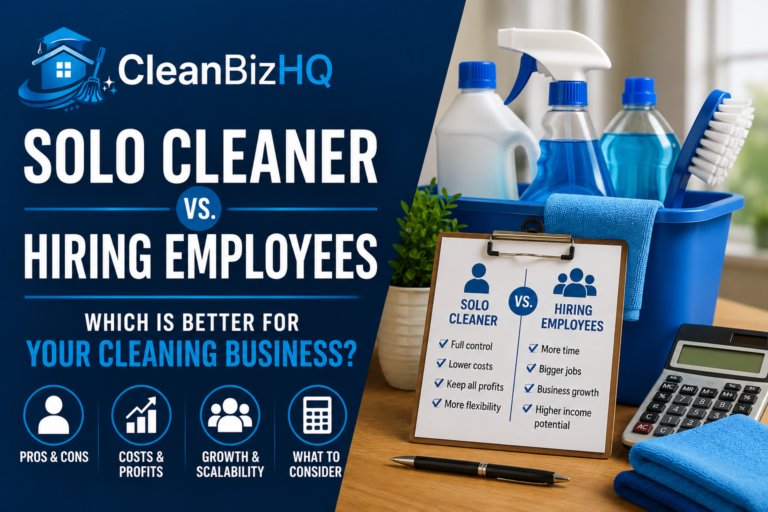
A solo owner may keep a high share of sales because the owner performs the labor. A staffed company usually keeps a smaller percentage of each sales dollar, but it has the capacity to complete far more work.
How Much Can a Solo Cleaning Business Owner Make?
A solo cleaning business is usually the fastest path to positive cash flow because payroll and management expenses are limited. The tradeoff is that the owner’s body and schedule become the company’s main production capacity.
| Calculation | Amount |
|---|---|
| 20 recurring jobs per week | 20 jobs |
| Average job price | $150 |
| Weekly revenue | $3,000 |
| Annual revenue at 48 working weeks | $144,000 |
| Illustrative business expenses at 25% | $36,000 |
| Remaining before personal taxes | $108,000 |
That example looks highly profitable because the owner personally performs the cleaning. A better management view is to assign a wage value to the owner’s labor.
Suppose the owner values cleaning labor at $25 per hour and works 40 production hours per week for 48 weeks. That labor is worth $48,000. After recognizing that labor value, the remaining return for ownership and management would be closer to $60,000 before personal taxes.
This distinction matters when deciding whether to hire. If the business only works because the owner provides unpaid labor, the company may not yet have a repeatable employee-based model.
How Much Can a Small Cleaning Company Make?
A small company with two to four cleaners can produce more revenue than a solo operator, but payroll becomes the largest expense.
| Calculation | Amount |
|---|---|
| Monthly revenue | $25,000 |
| Cleaner wages and payroll burden | $12,000 |
| Supplies and job costs | $1,500 |
| Insurance, software, vehicles, marketing, and overhead | $4,000 |
| Operating profit before owner taxes | $7,500 |
| Annualized operating profit | $90,000 |
The example produces a 30% operating margin. Whether that is achievable depends on pricing, travel time, rework, employee utilization, customer retention, and how much day-to-day work the owner performs.
The SBA notes that an employee’s true cost can be higher than base wages because payroll taxes, insurance, benefits, training, and other expenses must be considered.
How Much Can a Larger Cleaning Company Make?
A cleaning company with several crews can reach high revenue because the owner is no longer limited to personally completing every job.
However, larger revenue brings additional costs: supervisors, office staff, recruiting, employee turnover, quality control, workers’ compensation, vehicles, management software, and customer service.
| Annual Revenue | 20% Operating Profit | 30% Operating Profit | 40% Operating Profit |
|---|---|---|---|
| $250,000 | $50,000 | $75,000 | $100,000 |
| $500,000 | $100,000 | $150,000 | $200,000 |
| $750,000 | $150,000 | $225,000 | $300,000 |
| $1,000,000 | $200,000 | $300,000 | $400,000 |
These figures simply show the mathematical effect of different margins. They are not claims that every cleaning company achieves those margins.
At this level, the owner may take compensation through salary, distributions, or another structure depending on the business entity and tax setup. Work with a qualified accountant to determine the correct approach.
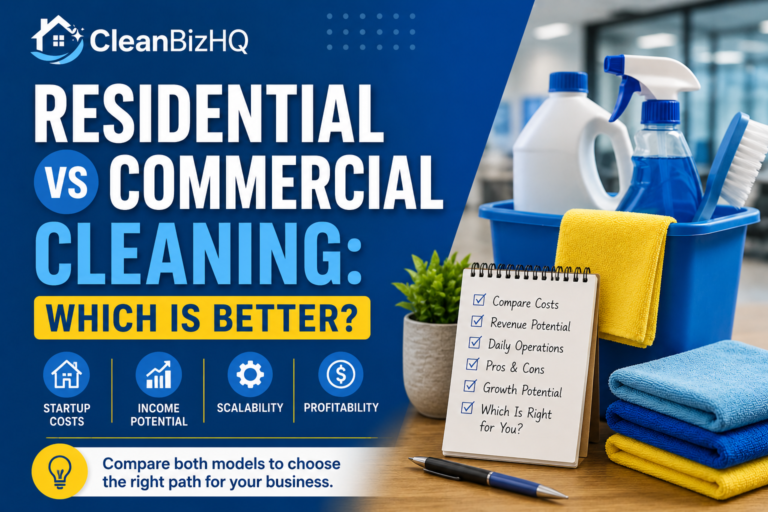
Residential vs. Commercial Cleaning Income
Residential and commercial cleaning can both be profitable, but their revenue patterns are different.
| Factor | Residential Cleaning | Commercial Cleaning |
|---|---|---|
| Typical schedule | Daytime, recurring weekly or biweekly | Evenings, nights, or scheduled facility hours |
| Customer value | Smaller individual accounts | Potentially larger contracts |
| Sales cycle | Often faster | Often longer with bids and approvals |
| Customer concentration | Many smaller customers | Fewer, larger customers |
| Risk of losing one account | Usually smaller | Can be significant |
| Staffing | Smaller teams are common | Larger crews may be needed |
| Pricing approach | Per visit, hourly, or flat rate | Contract, square footage, scope, and frequency |
Residential cleaning often allows a new owner to build recurring revenue faster. Commercial work may create larger contracts, but bidding mistakes can become expensive because labor requirements are repeated over a long contract period.
The Biggest Factors That Control Owner Earnings
1. Pricing
Underpricing is one of the fastest ways to build a busy but unprofitable cleaning business. Every quote should cover labor, payroll burden, supplies, travel, overhead, profit, and the risk of underestimating the job.
2. Recurring Customers
Weekly, biweekly, and recurring commercial accounts reduce the time and money spent constantly replacing one-time customers.
3. Labor Efficiency
Track estimated labor hours against actual labor hours. A small time overrun repeated across hundreds of jobs can erase profit.
4. Travel Time
A tightly grouped service area allows cleaners to complete more billable work. A scattered route increases fuel, windshield time, late arrivals, and payroll without increasing customer revenue.
5. Customer Retention
Service quality, communication, reliability, and quick issue resolution protect recurring revenue.
6. Employee Turnover
Frequent turnover creates recruiting, background-check, training, scheduling, and quality-control costs.
7. Service Mix
Deep cleans, move-in or move-out jobs, recurring maintenance, carpet cleaning, windows, and add-on services have different labor and equipment requirements. Track each service separately.
8. Overhead
Software, vehicles, storage, office space, advertising, insurance, and management costs should help the company grow or operate more efficiently. Unnecessary overhead reduces the owner’s return.
How to Calculate Your Potential Cleaning Business Income
- Estimate monthly jobs by multiplying recurring weekly jobs by about 4.33 and adding expected one-time work.
- Calculate your actual average revenue per job.
- Multiply monthly jobs by average job price to estimate monthly revenue.
- Subtract direct job costs, including cleaner wages, payroll burden, supplies, laundry, and subcontractors.
- Subtract overhead such as insurance, vehicles, fuel, software, phone, advertising, accounting, and licensing.
- Assign a replacement cost to the owner’s cleaning and administrative labor.
- Set aside money for applicable taxes and reserves.
The IRS states that self-employed individuals generally file an annual return and may need to make quarterly estimated tax payments. Tax treatment depends on entity type and individual circumstances.
Cleaning Business Income Calculator Examples
Example A: Part-Time Side Business
| Calculation | Amount |
|---|---|
| 8 jobs per week | 8 |
| Average price | $140 |
| Monthly revenue | About $4,850 |
| Illustrative expenses at 30% | About $1,455 |
| Remaining before personal taxes | About $3,395 per month |
Example B: Full-Time Solo Owner
| Calculation | Amount |
|---|---|
| 18 jobs per week | 18 |
| Average price | $165 |
| Monthly revenue | About $12,860 |
| Illustrative expenses at 25% | About $3,215 |
| Remaining before owner labor and personal taxes | About $9,645 per month |
Example C: Small Team
| Calculation | Amount |
|---|---|
| Monthly revenue | $35,000 |
| Illustrative operating margin | 25% |
| Monthly operating profit | $8,750 |
| Annualized operating profit | $105,000 |
The solo example includes compensation for the owner’s cleaning work inside the amount remaining. The small-team example assumes employee labor has already been recorded as an expense.
What Is a Good Profit Margin for a Cleaning Business?
There is no single correct profit margin for every cleaning company. A solo owner-operator, a residential maid service, and a commercial janitorial company use different labor and overhead structures.
| Planning Scenario | Operating Margin | What It May Indicate |
|---|---|---|
| Thin margin | 10% | Little room for errors, cancellations, or growth investment |
| Moderate margin | 20% | Potentially sustainable if owner labor is fully counted |
| Strong margin | 30% | Good pricing and cost control may be present |
| High margin | 40%+ | Possible in some owner-operated models; verify owner labor is not being treated as free |
A high reported margin is not automatically better if the owner works long hours without a fair wage. Measure both business profit and compensation for labor.
How to Increase What You Make
✓ Raise prices when jobs consistently take longer than estimated.
✓ Create minimum job prices to cover travel and setup time.
✓ Prioritize recurring customers over low-value one-time work.
✓ Group customers by service area and route.
✓ Offer profitable add-ons such as inside appliances, interior windows, or deep-clean upgrades.
✓ Track revenue and labor by customer.
✓ Stop accepting services you cannot price accurately.
✓ Use checklists and training standards to reduce callbacks.
✓ Automate scheduling, reminders, estimates, invoices, and payment collection.
✓ Review financial statements monthly.
✓ Build cash reserves before adding major overhead.
✓ Hire only when pricing can support the full employee cost.
A business can grow revenue while owner income declines. Review every growth decision based on the additional profit it is expected to create.
Common Reasons Cleaning Businesses Make Less Than Expected
- Quoting from competitor prices instead of actual costs
- Ignoring unpaid travel and setup time
- Failing to charge for first-time or deep-clean conditions
- Scheduling cleaners inefficiently
- Hiring before recurring revenue is stable
- Keeping unprofitable customers
- Not tracking employee hours against estimates
- Allowing excessive rework and callbacks
- Mixing business and personal money
- Treating taxes as an unexpected expense
- Buying vehicles, office space, or software too early
- Focusing on revenue instead of cash flow and profit
The cure is consistent job costing. For each service, compare revenue with direct labor, payroll burden, supplies, travel, payment fees, and a share of overhead.
Can You Make $100,000 a Year Owning a Cleaning Business?
Yes, it is mathematically possible for a cleaning business owner to earn $100,000 per year, but the required revenue depends on the true operating margin.
| Operating Margin | Annual Revenue Needed for $100,000 Profit |
|---|---|
| 15% | About $666,667 |
| 20% | $500,000 |
| 25% | $400,000 |
| 30% | About $333,333 |
| 40% | $250,000 |
A solo owner may report $100,000 of income at lower revenue because the owner is also being paid for personally completing the cleaning. A manager-led company must pay employees to do that work before calculating ownership profit.
Can a Cleaning Business Reach $1 Million in Revenue?
Yes. One million dollars in annual revenue equals approximately $83,333 per month, $19,231 per week, or $3,846 per working day across 260 working days.
At an average ticket of $175, the company would need roughly 22 completed jobs per working day. That usually requires several crews, dependable scheduling, recruiting, quality control, customer service, and management.
Commercial contracts can reduce the number of individual accounts needed, but they may introduce larger payroll commitments and greater risk if one major contract is lost.
Owner Income vs. Employee Wages
Owning a cleaning business can offer more upside than working as a cleaner, but the owner also carries the financial risk and management responsibility.
The U.S. Bureau of Labor Statistics reported a median hourly wage of $17.27 for janitors and building cleaners in May 2024. Business owners are not wage employees, so their income is not represented by that figure.
Source: BLS Occupational Outlook Handbook.
An owner may earn more by combining cleaning labor, sales, scheduling, customer service, hiring, and business ownership. However, owners may also earn less during startup months, absorb unpaid administrative time, and cover losses when jobs are underpriced.
How Long Does It Take to Build Meaningful Income?
| Stage | Primary Goal |
|---|---|
| First 1–3 months | Validate pricing, earn reviews, and build the first recurring route |
| Months 3–6 | Improve estimating, retention, and weekly scheduling |
| Months 6–12 | Build consistent recurring revenue and document procedures |
| Year 2 and beyond | Add employees carefully, improve management, and expand profitable services |
Some owners grow faster because they begin with customers, experience, or capital. Others build more slowly while working another job. A slower profitable company is usually healthier than fast growth built on underpriced work.
How Much Should You Pay Yourself?
The owner should separate compensation for work performed from the return generated by ownership.
Owner-Operator
If you personally clean, schedule, sell, and manage, track the market value of each role. Your financial reports should show whether the company could afford to replace your labor.
Owner With Employees
Once employees complete most cleaning, the owner may receive compensation for management plus profit distributions depending on entity structure and tax advice.
Cash-Flow Rule
Do not empty the business account every time revenue arrives. Maintain funds for payroll, taxes, insurance, supplies, refunds, repairs, seasonal slowdowns, and unexpected losses.
A Realistic Path to Higher Owner Income
- Start with a narrow service area and a clear customer type.
- Calculate a minimum profitable price before taking jobs.
- Build recurring weekly and biweekly customers.
- Track estimated and actual labor time for every job.
- Create repeatable cleaning checklists and quality standards.
- Raise prices or remove work that consistently misses margin targets.
- Build a cash reserve.
- Document scheduling, customer communication, and payment processes.
- Hire only when recurring demand can support the full employee cost.
- Promote a dependable cleaner or supervisor before adding too many crews.
- Review profit by service, customer, crew, and route.
- Reinvest selectively in marketing and systems that produce measurable returns.
This path may be slower than chasing every available job, but it gives the owner a better chance of building transferable business value instead of creating a demanding self-employed job.
Final Answer: How Much Can You Make Owning a Cleaning Business?
A cleaning business can provide part-time income, replace a full-time salary, or grow into a company producing six figures in annual owner earnings.
The most important number is not revenue. It is the amount remaining after paying realistic labor costs, supplies, payroll burden, insurance, vehicles, software, marketing, overhead, and taxes.
A solo owner can potentially retain more of each sales dollar but is limited by personal capacity. A staffed company can reach much higher revenue, but it requires disciplined pricing, labor control, recruiting, training, customer retention, and financial management.
Build your estimate from jobs, prices, labor hours, and expenses rather than relying on broad income claims. When each job is profitable and the work can be repeated without depending entirely on the owner, the business has real growth potential.
Frequently Asked Questions
How much does the average cleaning business owner make?
There is no single reliable amount that applies to every owner. A part-time solo operator, a full-time cleaner, and an owner managing multiple crews have completely different revenue and expense structures.
Can a cleaning business owner make $100,000 per year?
Yes. At a 25% operating margin, a company would need approximately $400,000 in annual revenue to generate $100,000 in operating profit. A solo owner may reach $100,000 of income at lower revenue because the owner personally performs much of the labor.
How much can a solo cleaning business make?
A full-time solo owner may generate several thousand dollars per month or more, depending on prices, schedule, travel, cancellations, and expenses. The owner should assign a value to personal cleaning labor when measuring true business profit.
Is residential or commercial cleaning more profitable?
Either can be profitable. Residential cleaning often provides faster sales and recurring weekly or biweekly work. Commercial cleaning may provide larger contracts but can involve longer sales cycles, tighter bidding, evening work, and greater dependence on fewer customers.
What is a good cleaning business profit margin?
There is no universal target. Model several scenarios such as 10%, 20%, 30%, and 40%, then verify that owner labor and all business costs are included.
How much revenue does a cleaning business need to make $100,000 profit?
At a 20% operating margin, about $500,000. At 25%, about $400,000. At 30%, about $333,333. At 40%, about $250,000.
Can a cleaning business make $1 million per year?
Yes. One million dollars in annual revenue is about $83,333 per month or $19,231 per week. Reaching that level usually requires multiple crews, reliable systems, customer retention, recruiting, and strong financial controls.
What expenses reduce cleaning business profit?
Common expenses include wages, payroll taxes, workers’ compensation, supplies, fuel, vehicles, insurance, software, advertising, card-processing fees, uniforms, training, office costs, accounting, and taxes.
Should I count my own labor as an expense?
Yes, at least for management analysis. Assigning a replacement cost to your cleaning and administrative work shows whether the business can eventually operate without depending on unpaid owner labor.
How can I make more money with a cleaning business?
Improve pricing, increase recurring customers, reduce travel, track labor against estimates, add profitable services, retain good employees, remove unprofitable accounts, and review financial results every month.
Do cleaning business owners pay quarterly taxes?
Many self-employed individuals may need to make quarterly estimated tax payments. Requirements depend on entity structure, income, deductions, and individual circumstances.
Is cleaning business revenue the same as take-home pay?
No. Revenue is total customer sales. Take-home pay is what the owner keeps after business expenses and applicable personal taxes.
Continue Learning About Starting and Growing a Cleaning Business
Use these CleanBizHQ guides to turn your income goal into a practical business plan.
Ready to Build a Profitable Cleaning Business?
Start with realistic pricing, recurring customers, careful expense tracking, and systems that allow the company to grow without depending entirely on your personal labor.