Solo Cleaner vs. Hiring Employees: Which Is Better for Your Cleaning Business?
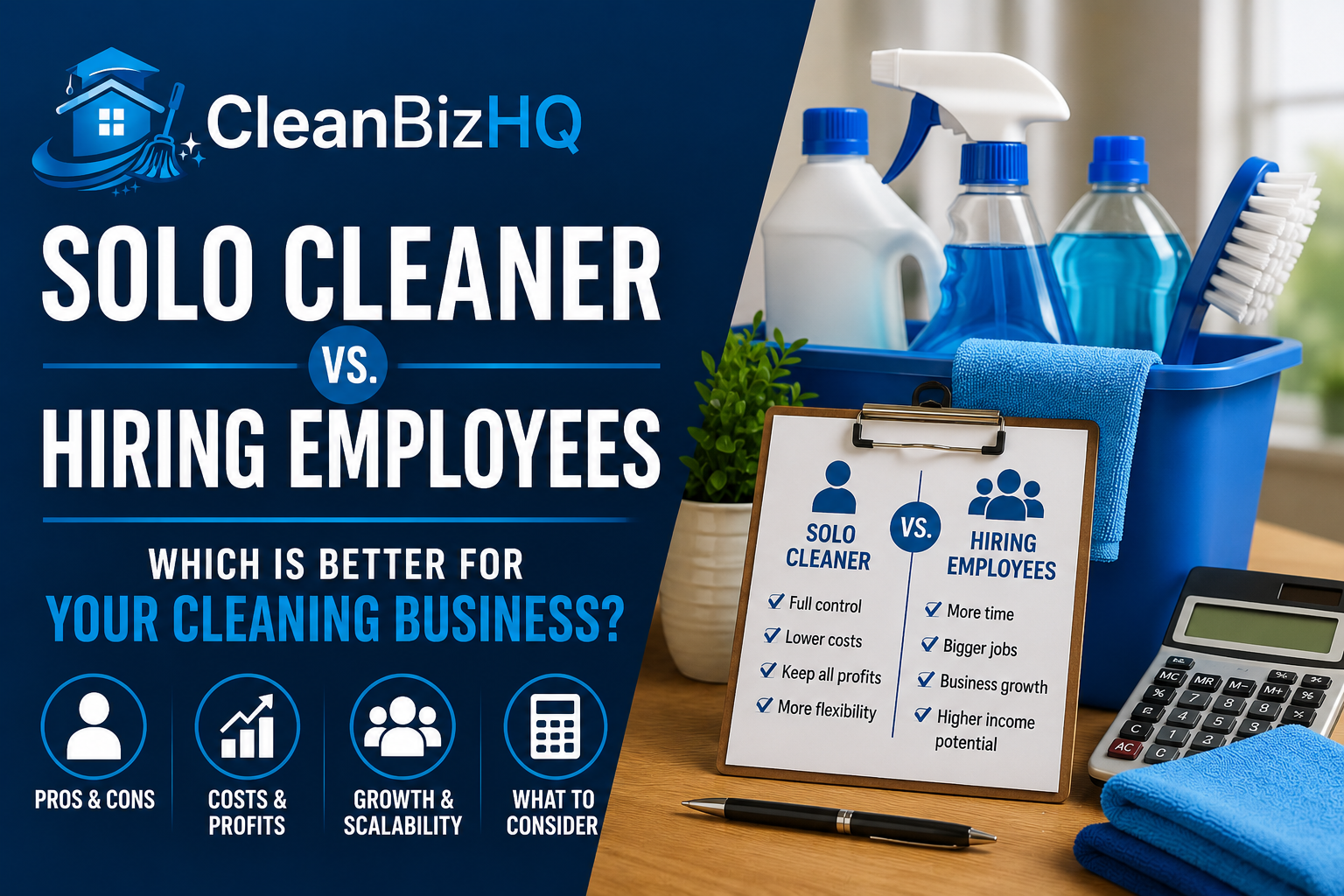
Choosing between a solo cleaner vs. hiring employees is one of the biggest decisions a cleaning-business owner will make. Staying solo can provide lower overhead, more control, and a simpler operation, while hiring employees can increase capacity and help the business grow beyond the owner’s personal cleaning hours.
Neither option is automatically better. The right choice depends on your income goals, available work, pricing, cash reserves, systems, and whether you actually want to manage a team.
This guide compares the costs, benefits, risks, and growth potential of staying solo versus hiring cleaning employees.
Quick Answer: Should You Stay Solo or Hire Employees?
Stay solo if you value direct control, lower overhead, predictable quality, and a simpler schedule. Consider hiring employees when you are consistently turning away profitable work, have documented systems, can support payroll during slower periods, and want to build a company that can operate beyond your own cleaning hours.
Solo Cleaner vs. Hiring Employees at a Glance
The biggest difference is leverage. A solo cleaner earns primarily from personal labor. An employer earns from a system that allows multiple people to complete work.
| Factor | Solo Cleaner | Hiring Employees |
|---|---|---|
| Overhead | Lower | Higher |
| Quality control | Direct control | Requires training and inspections |
| Income ceiling | Limited by personal hours | Can grow with team capacity |
| Scheduling | Simpler | More moving parts |
| Administrative work | Lower | Payroll, hiring, policies, and management |
| Time away from work | Revenue may stop | Possible with reliable staff and systems |
| Risk | Lower fixed costs | Higher payroll and operational risk |
That additional leverage can increase revenue, but it does not automatically increase profit. A poorly managed team can produce more sales while leaving the owner with more stress and less money.
Benefits of Staying a Solo Cleaner Instead of Hiring Employees
Lower overhead
You avoid employee payroll, recruiting costs, additional uniforms, extra equipment, and many of the administrative expenses that come with managing a team.
More consistent quality
You know exactly how each home or facility is cleaned because you perform the work yourself. There is less risk of another cleaner missing details or delivering a different standard.
More personal control
You choose your customers, schedule, service area, pricing, and workload without coordinating multiple people.
Simpler operations
A solo business still needs bookkeeping, insurance, scheduling, and customer communication, but it is generally easier to manage.
Stronger customer relationships
Many residential clients appreciate seeing the same trusted cleaner at every visit. That consistency can improve retention and referrals.
Disadvantages of Staying Solo
- Your income is tied to your available hours. You can raise prices and improve efficiency, but you can only complete so many jobs each week.
- Time off can stop production. Vacations, illness, family emergencies, and injuries may immediately reduce revenue.
- You handle every role. Cleaning, estimates, scheduling, invoicing, marketing, and customer service remain your responsibility.
- Large contracts may be out of reach. Some commercial accounts and property portfolios require more labor than one person can provide.
- The work can become physically difficult. Depending entirely on your own labor may become harder over time.
A Solo Business Can Still Be Successful
You do not have to build a large cleaning company to succeed. A well-priced solo business with efficient routes, recurring customers, and low overhead can be highly profitable.
Advantages of Hiring Employees
More service capacity
A trained team can serve more customers, cover larger facilities, and complete multiple jobs at the same time.
More revenue potential
Hiring allows the company to earn beyond the number of jobs the owner can personally complete.
Access to larger accounts
Employees can make commercial contracts, property-management portfolios, move-out projects, and multi-location work more realistic.
Less dependence on your own labor
Over time, the owner can move away from cleaning every job and focus more on sales, quality control, hiring, systems, and growth.
A business that may operate without you
With reliable staff, supervisors, and documented systems, the company may eventually continue producing revenue while the owner steps away from daily cleaning.
Disadvantages of Hiring Employees
- Payroll becomes an ongoing obligation. Employees must be paid even when a customer pays late or the schedule has gaps.
- Hiring takes time. Recruiting, interviewing, screening, onboarding, and replacing workers can become a major responsibility.
- Training must be repeatable. Employees need clear procedures for cleaning, safety, keys, alarm codes, and customer communication.
- Quality may vary. Without inspections and accountability, service can become inconsistent.
- Turnover can disrupt the schedule. Losing one dependable cleaner can affect several customer accounts.
- Administrative requirements increase. Payroll, timekeeping, insurance, employment records, and workplace policies require attention.
- Your job changes. You become responsible for managing people, not only cleaning properties.
Signs You May Be Ready to Hire
Hiring because you feel busy is not enough. The business should be financially and operationally prepared.
- You regularly turn away profitable work. Demand should be consistent rather than based on one unusually busy week.
- Your pricing supports labor costs. Each job must cover wages, payroll expenses, supplies, travel, overhead, and profit.
- Your cleaning process is documented. New workers should not have to guess how jobs are completed.
- You have cash reserves. The business should be able to cover payroll when customers pay late, cancel, or reduce service.
- Your schedule is organized. Routes, appointment details, and customer communication should already be reliable.
- You are willing to manage people. Hiring replaces some cleaning work with leadership, training, and supervision.
- You have repeatable training. Your quality standard should be teachable and easy to inspect.
Before hiring, strengthen your cleaning business systems → so the company is not dependent on memory and verbal instructions.
A Safer Way to Make the First Hire
You do not have to jump from solo cleaner to a large payroll. Many owners grow gradually.
- Raise prices and remove low-profit customers.
- Improve route density and reduce unpaid drive time.
- Standardize checklists, supplies, and service procedures.
- Add a part-time employee for the busiest days.
- Train one dependable cleaner before adding several people.
- Build enough recurring work to support predictable hours.
- Review profitability before each additional hire.
This staged approach gives you time to learn hiring and supervision without taking on more payroll than the business can support.
Recommended Tool for Scheduling a Growing Team
As soon as more than one cleaner is handling jobs, organized scheduling and customer records become much more important. BookingKoala can help service businesses manage bookings, job details, and day-to-day operations in one place.
How Hiring Changes Your Finances
Adding employees can increase revenue, but it also creates new costs that must be built into your prices.
- Hourly wages
- Payroll taxes and payroll processing
- Workers’ compensation coverage when required
- Training time
- Uniforms and supplies
- Additional equipment
- Travel time
- Supervision and quality inspections
- Employee turnover and replacement costs
Review our best payroll software for cleaning businesses → before choosing how you will manage payroll and employee records.
Recommended Tool for Business Finances
A growing cleaning business needs organized invoices, expenses, and payment records. FreshBooks can help small service businesses create professional invoices and keep their finances organized as the company expands.
Employee or Independent Contractor? Do Not Treat Them as Interchangeable
A worker is not automatically an independent contractor simply because you pay by the job or issue a contractor tax form. Worker classification depends on the actual working relationship and applicable federal and state rules.
Do not choose contractor status merely to avoid payroll responsibilities. Review the current requirements with a qualified accountant, payroll professional, or employment attorney before classifying workers.
Our cleaning business structure guide → explains the broader systems and professional support a growing company may need.
Solo Cleaner vs. Hiring Employees: How to Choose
Stay solo when you want
- Lower overhead
- Direct control over every job
- A flexible personal schedule
- Fewer administrative responsibilities
- A smaller customer list with stronger margins
- A business designed primarily around your own income
Hire employees when you want
- More service capacity
- Larger residential or commercial accounts
- A company that can operate beyond your personal labor
- A management and leadership role
- A higher growth ceiling
- To build a business asset rather than only create a personal job
The Real Question
Do not ask only, “Can I hire someone?” Ask, “Do I want to run a team, and does the business have the pricing, systems, demand, and cash flow to support one?”
Final Verdict
Staying solo is usually better for simplicity, control, and lower risk. Hiring employees is better for capacity, scale, and building a business that is less dependent on your own cleaning hours.
A solo cleaner should not feel pressured to hire simply because growth is treated as the only definition of success. A smaller operation can still provide excellent income and freedom.
When demand is consistent, pricing is profitable, systems are documented, and you genuinely want to manage people, hiring can become the next logical step.
For more guidance on building the company correctly from the beginning, read our how to start a cleaning business guide →.
Frequently Asked Questions
When should a solo cleaner hire the first employee?
Consider hiring when you consistently turn away profitable work, have documented cleaning and scheduling systems, can support payroll during slower periods, and are prepared to train and supervise another person.
Is a solo cleaning business profitable?
Yes. A solo cleaning business can be profitable when services are priced correctly, routes are efficient, customers are recurring, and overhead is controlled.
Will hiring employees automatically increase profit?
No. Employees can increase revenue and capacity, but wages, payroll costs, training, supervision, turnover, and unproductive time can reduce profit if the business is not managed carefully.
Should I hire part time or full time first?
Many owners begin with part-time help because it limits payroll risk and allows the new employee to cover the busiest days. The right choice depends on the recurring work and hours you can reliably provide.
Can I call my cleaner an independent contractor instead of an employee?
Worker classification depends on the actual working relationship and current federal and state rules. Get professional guidance rather than choosing a label based only on convenience.