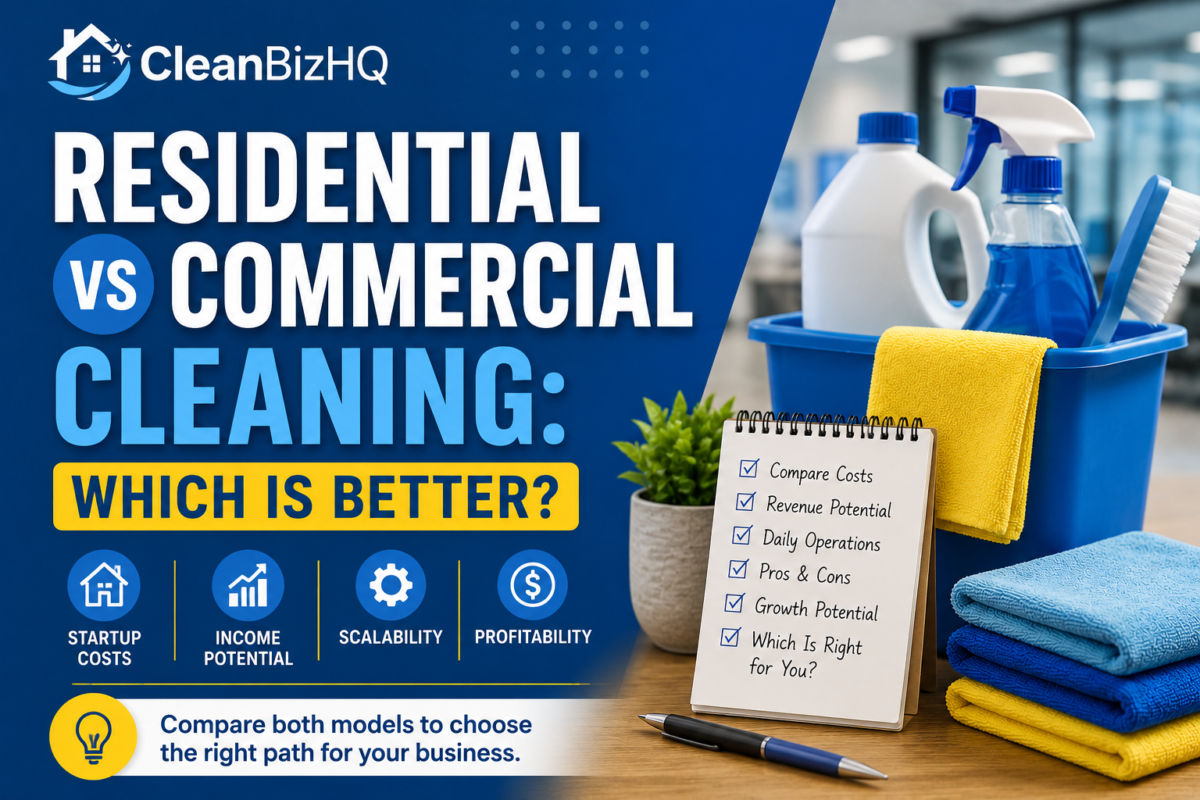
Residential vs Commercial Cleaning: Which Is Better?
Choosing between residential cleaning and commercial cleaning is one of the biggest decisions new cleaning business owners make.
The good news is there is no wrong answer.
Both business models can be highly profitable, scalable, and rewarding. The best option depends on your goals, schedule, startup budget, and long-term vision for your company.
In this guide, we’ll compare residential and commercial cleaning to help you decide which path is right for your business.
What Is Residential Cleaning?
Residential cleaning involves cleaning homes, apartments, condos, and vacation rentals.
Typical residential services include:
- Weekly cleaning
- Bi-weekly cleaning
- Monthly cleaning
- Move-in and move-out cleaning
- Deep cleaning
- Vacation rental turnovers
Most residential cleaning takes place during normal business hours between 8 AM and 5 PM.
Residential Cleaning Pros
Higher Hourly Rates
Residential cleaning often produces higher hourly earnings than commercial cleaning.
Many residential cleaning companies charge:
- $150-$250 per cleaning
- $40-$75 per labor hour
- Premium rates for deep cleaning services
Easier To Start
Residential cleaning has lower startup costs and fewer barriers to entry.
Many businesses launch with:
- Basic supplies
- Insurance
- Transportation
- A website
Some cleaning companies start for less than $2,000.
If you’re still setting up your business structure, check out our Cleaning Business Structure Checklist and How to Start a Cleaning Business Guide.
Faster Payments
Most residential customers pay immediately after service.
Payment options often include:
- Credit cards
- ACH payments
- Online invoices
- Automatic recurring billing
We recommend using Square for simple payments or Helcim for businesses looking to automate recurring billing and online payments.
Easier Customer Acquisition
Getting your first residential clients is often easier than winning commercial contracts.
Popular customer acquisition methods include:
- Google Business Profile
- Facebook Groups
- Referrals
- Yard signs
- Door hangers
Residential Cleaning Cons
More Customer Communication
Residential customers typically require more communication, scheduling changes, and service customization.
More Travel Time
Residential cleaners often drive between multiple homes each day which can reduce efficiency.
More Cancellations
Homeowners cancel and reschedule more frequently than commercial accounts.
What Is Commercial Cleaning?
Commercial cleaning involves cleaning businesses and commercial properties such as:
- Offices
- Medical buildings
- Retail stores
- Churches
- Warehouses
- Professional offices
- Industrial facilities
Commercial work often takes place during evenings or weekends after businesses close.
Commercial Cleaning Pros
Recurring Monthly Revenue
Commercial contracts create predictable income.
Instead of booking individual cleanings each week, many businesses sign contracts ranging from:
- $500 per month
- $1,000 per month
- $5,000+ per month
Recurring revenue makes growth easier and more predictable.
Easier To Scale
Commercial cleaning companies often scale faster because employees can service multiple buildings using standardized systems.
As your team grows, software becomes increasingly important.
Many commercial cleaning companies use Jobber or Housecall Pro to manage:
- Scheduling
- Dispatching
- Estimates
- Invoices
- Customer communication
Less Customer Interaction
Commercial clients generally expect consistent service but require less day-to-day communication than residential customers.
Larger Contracts
Landing a few large commercial contracts can replace dozens of residential customers.
Many cleaning business owners appreciate the stability that commercial contracts provide.
Commercial Cleaning Cons
Longer Sales Cycle
Commercial contracts can take weeks or months to secure.
Decision makers may include:
- Property managers
- Office managers
- Facility directors
- Business owners
Higher Insurance Requirements
Commercial clients often require higher insurance limits.
Most commercial cleaning companies carry:
- General liability insurance
- Workers compensation insurance
- Commercial auto insurance
We recommend comparing providers such as NEXT Insurance, Hiscox, and Simply Business to find the best fit for your company.
Larger Competition
Commercial cleaning often involves competing against established local and regional companies.
Startup Cost Comparison
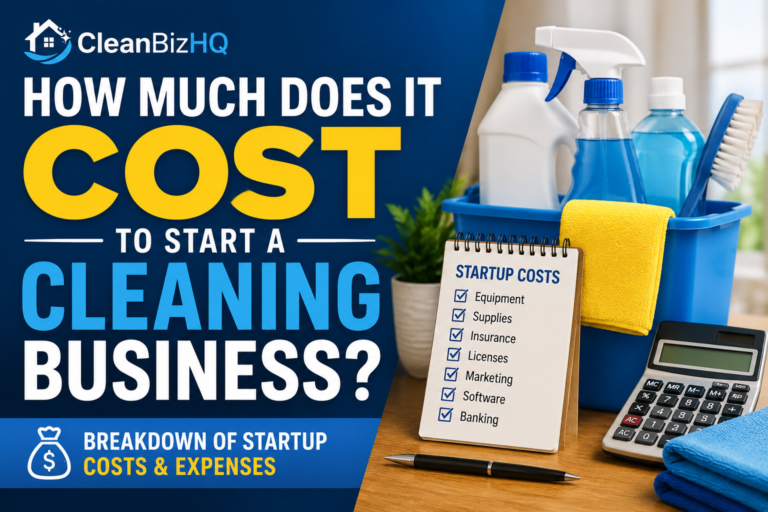
Residential Cleaning Startup Costs
Typical startup investment:
- Supplies: $300-$800
- Insurance: $500-$1,000 annually
- Marketing: $200-$500
- Website: $100-$500
Estimated startup cost:
$1,000-$2,500
Commercial Cleaning Startup Costs
Typical startup investment:
- Equipment: $1,000-$3,000
- Insurance: $1,000-$2,500 annually
- Marketing: $500-$1,000
- Software and systems: $50-$200 monthly
Estimated startup cost:
$2,500-$7,500+
Which Makes More Money?
Residential Cleaning
Potential annual revenue:
- Solo owner: $50,000-$120,000+
- Small team: $150,000-$500,000+
Commercial Cleaning
Potential annual revenue:
- Solo owner: $75,000-$150,000+
- Established company: $500,000-$5M+
Commercial cleaning generally offers higher long-term revenue potential due to larger recurring contracts.
Which Is Better For Beginners?
Residential cleaning wins for most new business owners.
Advantages include:
- Lower startup costs
- Easier customer acquisition
- Faster cash flow
- Simpler operations
Many successful companies begin with residential clients and later expand into commercial cleaning.
Our Recommendation
If you’re starting with limited capital and no experience:
✓ Start with residential cleaning.
If your goal is building a large operation with employees and recurring contracts:
✓ Focus on commercial cleaning.
The best long-term strategy for many businesses is eventually offering both services.
Final Thoughts
Residential cleaning offers lower startup costs, faster payments, and easier customer acquisition.
Commercial cleaning offers recurring contracts, larger accounts, and stronger long-term scalability.
Neither option is wrong.
Choose the model that best aligns with your goals, budget, and preferred lifestyle.
Many of the largest cleaning businesses in America successfully operate both residential and commercial divisions.